
How to Use a Vinegar Cleaning Solution for Washing Machine Odor, Gunk and That Musty Smell
You know the moment. You open the washer door expecting clean laundry smells, and instead you get a sour, swampy whiff that seems to soak straight into the towels. It is frustrating, because the machine that is supposed to clean your clothes is somehow the dirtiest smelling thing in the laundry room. The good news: the smell almost never comes from the drum itself. It builds up in the rubber gasket, the detergent drawer and a film of old detergent residue, and a plain vinegar cleaning solution for washing machine odor handles all three, as long as the order and the amounts are right.
Key Takeaways
- Front loaders take 2 cups of white vinegar in an empty hottest, longest cycle. Top loaders take 4 cups with a one hour soak.
- The gasket and the detergent drawer cause most front loader smell, so clean them by hand before any cycle runs.
- Vinegar and baking soda always run in separate cycles. Mixed together in the drum, they mostly cancel each other out.
- Leave the door or lid ajar between loads, wipe the gasket dry, and do not overdose detergent. Those habits stop the smell returning.
- Never mix vinegar with bleach, and never run a vinegar cycle right after a bleach cycle without a plain hot rinse in between.
The Short Answer
To clean a smelly washing machine with vinegar, wipe the gasket folds and the detergent drawer first, then run an empty cycle on the hottest, longest setting with vinegar: 2 cups in the dispenser or drum of a front loader, or 4 cups added to a full tub of hot water in a top loader after a one hour soak. If you want baking soda too, run it afterwards in its own separate hot cycle, 1/2 cup for a front loader and 1 cup for a top loader. Wipe dry, leave the door or lid open, and repeat monthly.
Safety First, Before Any Vinegar Goes In
Please read this part properly, because this is where people get hurt with homemade cleaners.
Never mix vinegar with bleach, and never let one follow the other without rinsing. Vinegar is an acid, and acid meeting bleach makes chlorine gas, which can seriously damage lungs. If your machine was recently cleaned with bleach, run a plain hot rinse cycle first and let it finish completely before any vinegar goes in.
Check your manual too. Some manufacturers caution that frequent vinegar use can age rubber seals and hoses, and a few advise their own cleaning products or the tub clean cycle only. The monthly routine below is the standard middle path, but if your manual says no vinegar, the manual wins, especially while the machine is under warranty.
One honest limit: vinegar cleans, deodorizes and dissolves mineral and detergent residue. It is not a registered disinfectant, and nobody should promise you otherwise. And if the gasket has heavy mould soaked into the rubber itself, no cleaner may fully bring it back. Replacing the gasket is the honest endgame there.
What You Need
- Distilled white vinegar, the standard 5 percent kind
- Baking soda, optional, for the separate deodorizing cycle
- Two soft cloths and an old toothbrush
- Hot soapy water in a sink or basin
- A dry towel for the final wipe down
Front Loader Cleaning Routine, Step by Step
Step 1: Clean the gasket first
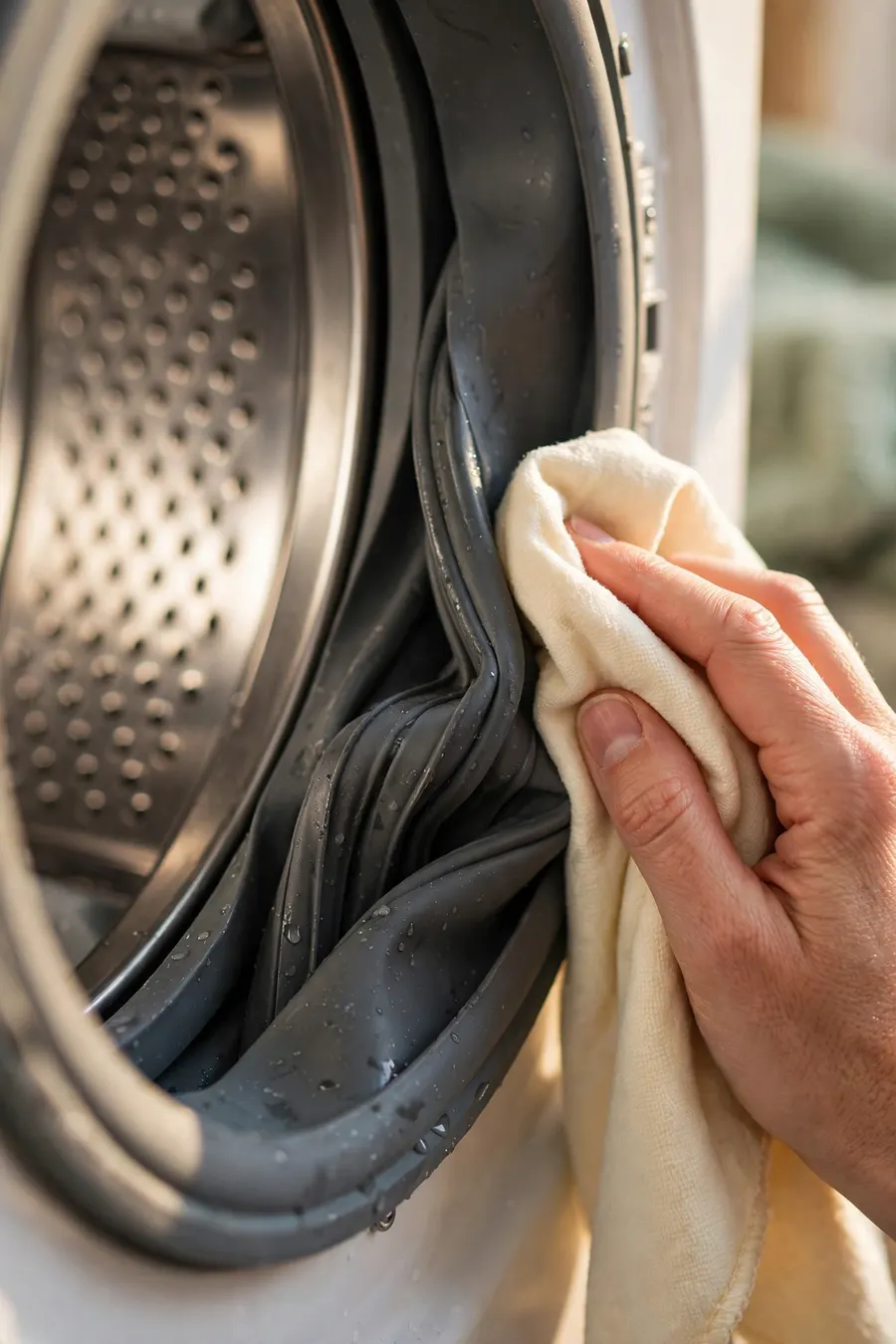
Pull back the rubber door seal and pick out any lint, hair and debris sitting in the folds. You may find coins, tissues and things you would rather not think about. Wipe every fold with a cloth dampened in a 1:1 mix of vinegar and water. For visible mould spots, hold the vinegar dampened cloth against the spot for several minutes before scrubbing gently with the old toothbrush. Wipe the seal dry when you finish. This step fixes more smell than any drum cycle, because the folds stay wet all week.
Step 2: Pull out and soak the detergent drawer

Pull the dispenser drawer out fully and soak it in hot soapy water. Scrub the residue out of every corner with the toothbrush, rinse it, dry it and put it back. While it soaks, wipe inside the drawer housing too. Old detergent turns sticky in there, and that film smells stale all on its own.
Step 3: Run the vinegar cycle
Add 2 cups of white vinegar to the detergent dispenser, or pour it directly into the drum. Run the machine empty on the hottest, longest setting it has. If your washer has a tub clean or sanitary cycle, use that one. This is the core of the vinegar cleaning solution for washing machine cleaning: hot water carries the vinegar through the drum and hoses, dissolving the mineral deposits and detergent film that feed the odor.
Step 4: Run the baking soda cycle separately, if you want it
Once the vinegar cycle has fully finished, sprinkle 1/2 cup of baking soda into the drum and run a second hot cycle. This is a deodorizing follow up only. It runs on its own so the soda and vinegar do not neutralize each other in the drum and waste both.
Step 5: Clean the drain pump filter
Most front loaders hide a drain pump filter behind a small panel at the lower front of the machine. Check your manual, then drain and clean the filter following its instructions. Trapped debris in that filter is a common hidden smell source that keeps working no matter how clean the drum is.
Step 6: Dry it and leave the door open
Wipe the drum and the gasket dry with the towel, then leave the door ajar so the inside can air out instead of staying damp.
Top Loader Cleaning Routine, Step by Step

Step 1: Fill the tub with hot water
Set the largest load size and the hottest water temperature. Let the tub fill, then pause the cycle.
Step 2: Add the vinegar and soak
Add 4 cups of white vinegar to the hot water. Close the lid and let the machine agitate for about 1 minute to mix everything, then pause it again and let the tub soak for 1 hour. That quiet soak is doing the real work, softening the residue ring that builds up around the waterline.
Step 3: Let the cycle finish
After the soak, let the cycle run through to the end completely.
Step 4: Run the baking soda cycle separately, if you want it
Refill the tub with hot water and add 1 cup of baking soda. Agitate briefly, soak for 30 minutes if you have the time, then let the cycle complete. Same rule as the front loader: soda gets its own cycle, after the vinegar, never in the same water.
Step 5: Scrub the parts your hands can reach
Scrub the top of the agitator, the underside of the lid and the rim of the tub with a cloth and the 1:1 vinegar and water mix. Wipe everything dry, then leave the lid open so the tub can air out.
The Habits That Stop the Smell Coming Back
A monthly clean only holds if the daily habits change a little, because a washer that stays wet and closed will grow the same smell again.
- Leave the door or lid ajar between loads so the drum actually dries out.
- Wipe the front load gasket dry after the last load of the day. It takes twenty seconds and it is the single best habit on this list.
- Take finished laundry out promptly. Wet clothes sitting in a closed drum plant the smell right back.
- Measure your detergent instead of pouring by feel. Extra detergent is a leading cause of the residue film that feeds odor. Use the dose for your load size and soil level, and HE machines need HE detergent.
- Run this full cleaning routine monthly, or sooner whenever the odor shows up again.
Common Mistakes
- Pouring vinegar and baking soda in together to save time. The acid and the base mostly neutralize each other into water, so both ingredients underperform. Separate cycles, every time.
- Running a cycle and calling it done. A drum only clean still smells if the gasket folds, the drawer and the filter were skipped.
- Using more vinegar than the amounts above. More is not better here. It only adds acid exposure for the seals and hoses.
- Closing the door the minute the cycle ends. That traps warm moisture in a dark drum, which is exactly what caused the problem.
- Overdosing detergent out of habit. The film it leaves behind is what the vinegar then has to remove, so the clean never quite catches up.
Frequently Asked Questions
Why does my front loader smell again a week after cleaning?
Usually the gasket folds or the dispenser drawer were skipped, or the door is kept closed between loads. Those three habits matter more than the drum cycle.
Can I put vinegar and baking soda in together to save time?
You will mostly neutralize both. Run them in separate cycles: vinegar first for residue and minerals, soda second for odor.
How much vinegar is too much?
The amounts in this routine, 2 cups for a front loader and 4 cups for a top loader at a monthly cadence, are the standard published guidance. More is not better. It just adds acid exposure for the seals.
Conclusion
A smelly washer is rarely a broken washer. It is usually a wet gasket, a gunky drawer and a film of detergent that nobody ever cleaned out, and a simple monthly routine handles all three. Clean the parts your hands can reach, run the vinegar cycle hot and empty, keep the soda in its own cycle, and let the machine dry with its door open. Do that once a month and opening the washer goes back to smelling like nothing at all, which is exactly what clean is supposed to smell like.