Dollar Tree DIY Organization for a Small Rental: Room by Room, Nothing Drilled
A small rental has a special kind of mess. The cabinets are deep enough to lose things in. The drawers are few. And every fix you dream up needs a drill you are not allowed to use. So things pile up on counters and chair backs, and the place feels smaller than it is, and a little unfair, if we are being honest.
You probably know the loop by heart. You tidy on Sunday, feeling proud. By Thursday the bathroom counter is covered again, because nothing has a set home. Here is the part worth hearing: the problem is rarely the stuff. It is that the stuff has nowhere assigned to land.
This article fixes the landing spots. Dollar tree diy organization works when you measure first, group by job, and give each group a bin, basket, hook, tray or riser that fits the exact spot. Three levels, all renter-safe. Nothing drilled. Nothing permanent. And everything can leave with you when you move, deposit intact.
The Whole Idea: Measure, Group, House It
- Measure every shelf, drawer and cabinet before you buy a single bin. The printable at the end carries the numbers.
- Group by job, not by room clutter: one bin, one job, one label.
- The finds that genuinely work: clear bins, handled baskets, adhesive hooks, shelf risers, trays and labels.
- Skip the flimsy stuff: thin wire risers under heavy loads, tiny decorative baskets and weak hooks fail fast.
- Every fix here is renter-safe. No drilling, no screws, nothing that costs you a deposit.
The Short Answer: Measure First, Then Buy the Bins
Dollar tree diy organization works in a small rental when you shop with measurements, not hope. Measure each spot first, group your things by the job they do, then match each group to a bin, basket, tray, riser or adhesive hook that fits that exact space. Do the free sorting first, buy the workhorses second, and save one small buy for the job the cheap finds cannot carry.
The 10-Second Check: Which Spot Annoys You Daily?
Three quick questions. Be honest, and they will show you exactly where to start.
Check 1: Which spot annoys you most, the one you see every day? Start there, not with the worst closet. A fix you see daily keeps you going to the next room.
Check 2: Do you own bins already, and are they empty or holding random stuff? Then Level 1 is your whole first job. The bins are not the problem. The missing groups and labels are.
Check 3: Can you drill, or is your lease strict? If drilling is off the table, every fix here still works. Hooks stick or hang over doors. Risers and bins just sit.
Level 1: Free, Empty It, Group It, Measure It
[Cost: Free | Time: 30 minutes for one room]
Level 1 costs nothing, and it is the step almost everyone skips. Do not. Buying organizers for unsorted clutter just gives the clutter nicer boxes to hide in.
Step 1: Pick one room and pull one zone out at a time. One drawer, one shelf, one cabinet. Empty it fully onto a table or the bed. A half-emptied shelf never gets sorted.
Step 2: Group by job, not by where things landed. Cleaning things together, morning routine things together, charging things together. A group you can name in a few words stays sorted. A group called “miscellaneous” is a junk pile with a label on it.
Step 3: Measure every space before anything goes back. Write down width, depth and height for each shelf, drawer and cabinet you emptied. These numbers go on the printable at the end, and they are the whole shopping list later.
Step 4: Put back only what earns its spot, in the containers you already own. Shoeboxes, jars and baskets in the house work as stand-ins. A group with no container yet goes on the list by its measurements, not a guess. Seasonal pieces get grouped the same way, so the dollar tree christmas decor diy pieces you made have one bin to come back to in January.
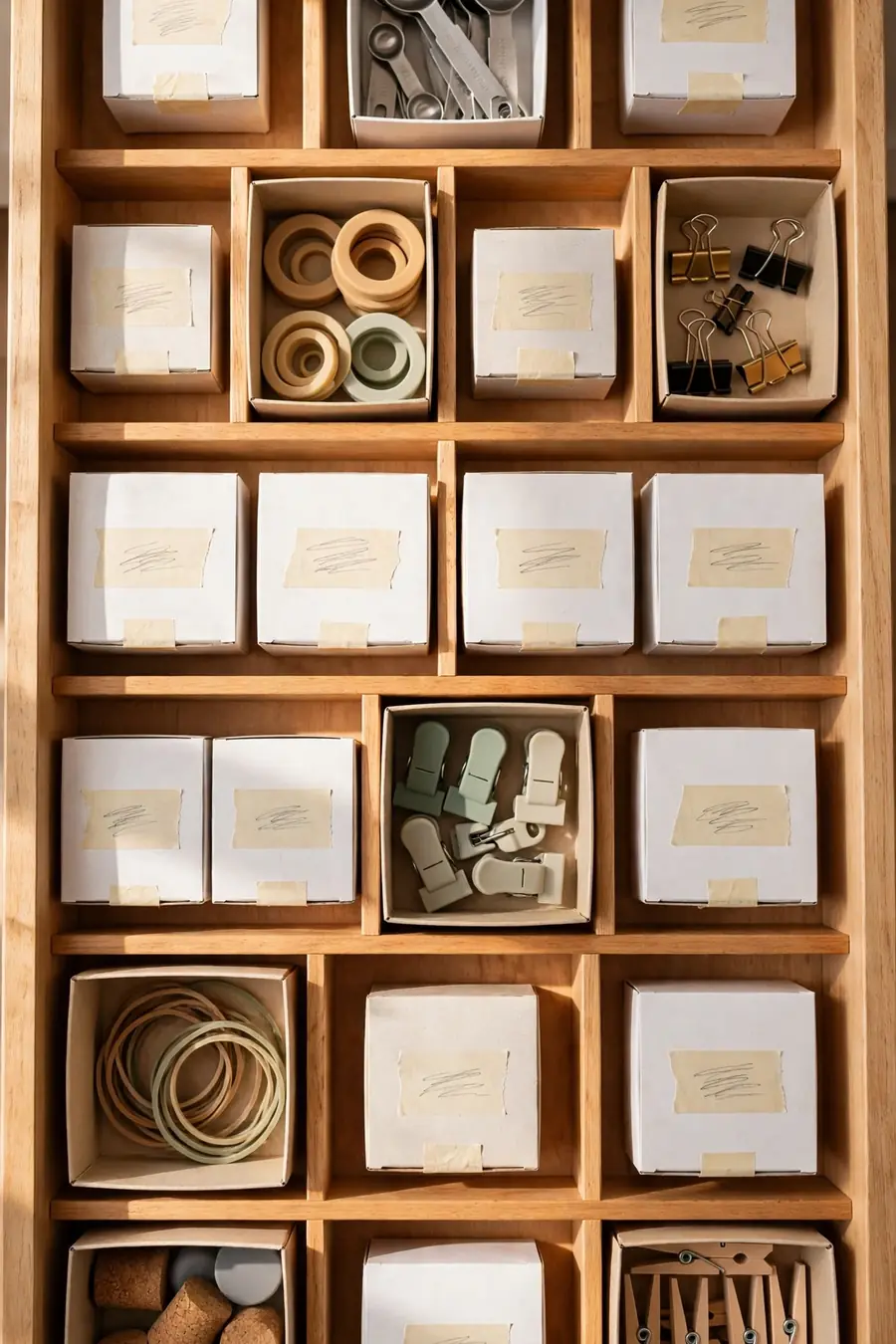
Step 5: Label what you grouped, with tape and a marker. Painter’s tape pulls off clean when a group changes, which matters in a rental. An unlabeled bin gets filled with whatever is closest. A labeled one stays honest.
Level 2: Dollar-Store and Thrift Finds, Matched to Your Numbers
[Cost: Dollar-store level | Time: 1 short trip, list in hand]
Level 2 is the shopping level, and the list comes from your Level 1 measurements, not from what looks cute in the aisle. Buy for named spots only. If you cannot name the exact shelf an item is for, it goes back on the shelf. Not in your cart.
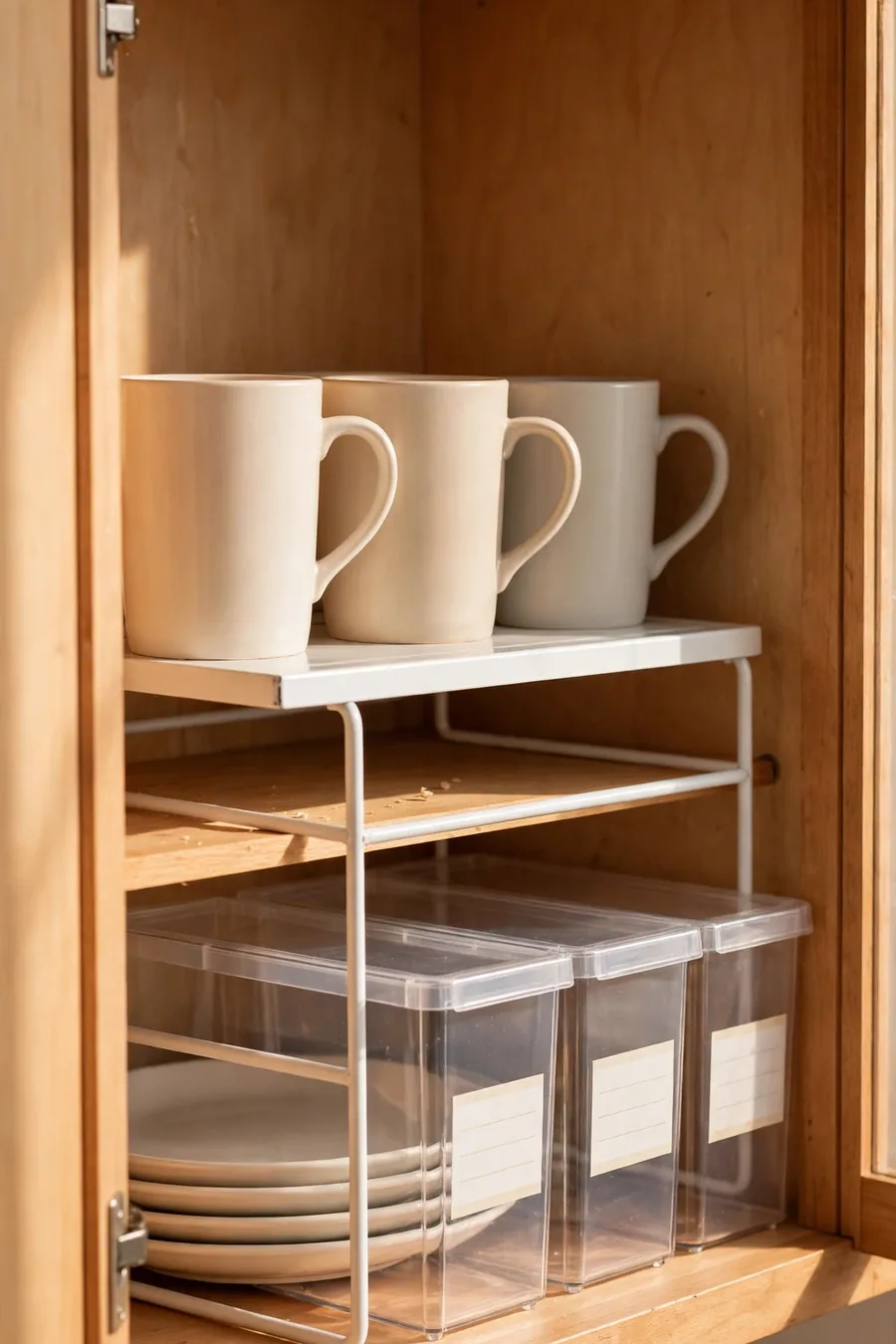
Step 1: Kitchen, bins for the deep cabinet. Deep rental cabinets swallow things. Small clear bins, one per job, turn them into pull-out drawers: one for cans, one for packets, one for baking bits. Clear matters, because seeing the contents ends the buying-a-second-one cycle. The same bins carry into the fridge organization ideas on this site.
Step 2: Kitchen, a riser and a tension rod. A cabinet shelf riser turns one shelf into two levels, mugs above and plates below, no screws. Keep risers for light loads. Under the sink, a small tension rod wedged across the cabinet holds spray bottles by their triggers, using the dead space above the pipes.
Step 3: Bathroom, trays and a caddy. A flat tray on the counter corrals the morning routine into one footprint, so the counter reads as tidy even on a rushed day. Under the sink, one handled caddy holds cleaning things and carries to any room. The small bathroom storage ideas here go deeper on the same room.
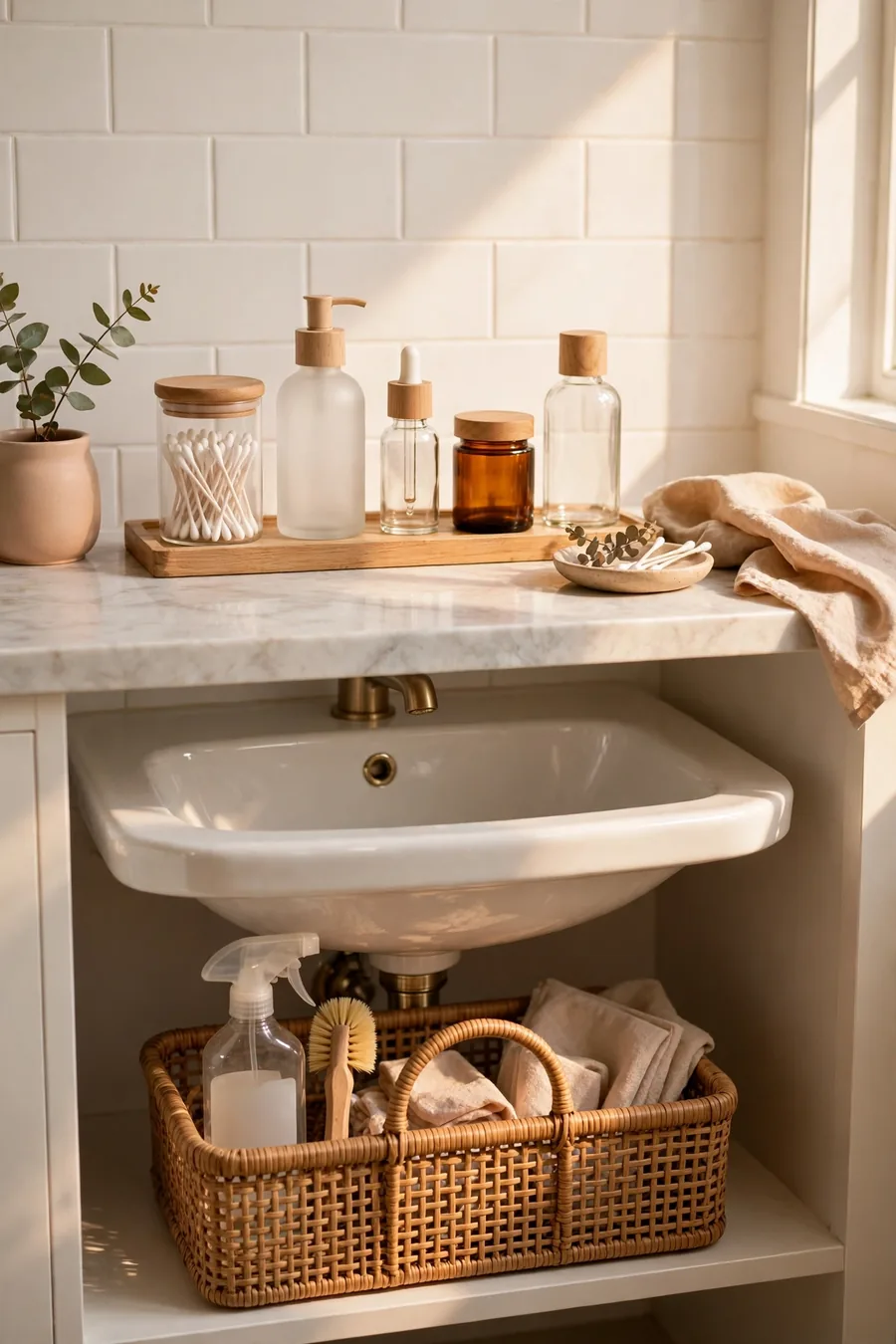
Step 4: Bedroom and closet, matching baskets. On open shelves, handled baskets beat bins because you see them all day. Pick one style and one color, and repeat it. Three matching baskets read as a system. Three different ones read as a yard sale. Use them for rolled tees, scarves and chargers.
Step 5: Everywhere, adhesive hooks and labels. Adhesive hooks go inside cabinet doors for measuring cups and lids, and by the entry for keys and light bags. Keep them to light jobs. A hook asked to carry a heavy coat will peel, usually at night, loudly. Label every bin the day it goes in.
Step 6: Know what to walk past. This is the honest part. Skip:
- Thin wire risers for heavy loads. They bend under books or stacked cans, and the bend is permanent.
- Tiny decorative baskets. They hold nothing and become clutter themselves.
- Flimsy fabric cubes that sag empty on the shelf.
- Bins stacked three high with heavy contents. Two high is steady. Three high wobbles.
- Anything bought without a named spot and a measurement. That is shopping, not organizing.
Level 3: One Small Buy, the Over-Door Rack That Works
[Cost: One small buy | Time: 10 minutes to hang]
Level 3 is one small buy for the one job dollar store finds do badly: carrying real daily weight at the door.
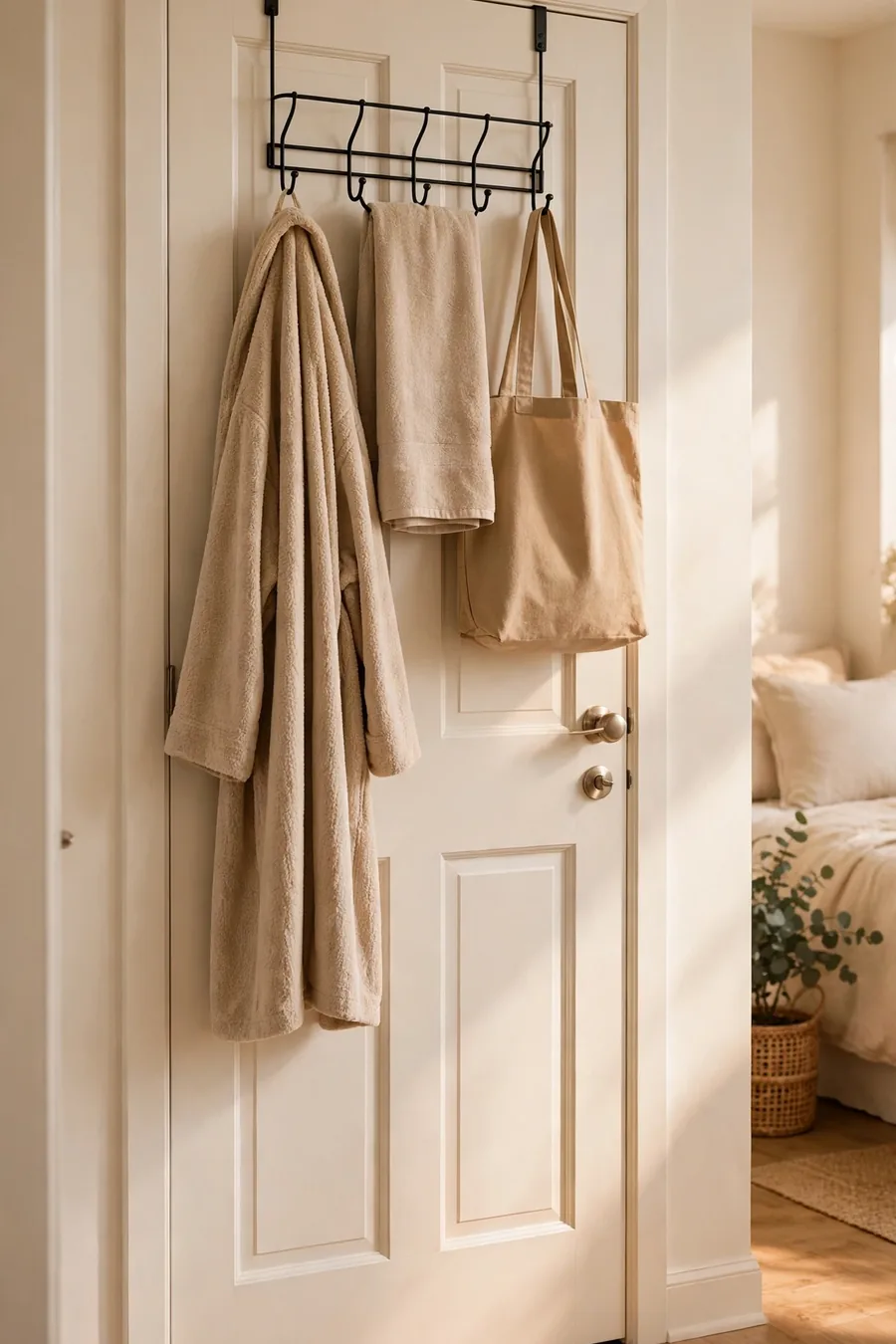
The buy: one sturdy over-the-door hook rack. The metal kind, with several pegs, that slips over the top of a door. No drilling, no adhesive, and it lifts straight off when you move. Give it the heavy daily jobs: the robe, the towel in use, tomorrow’s outfit, the bag you grab every morning.
Why this one buy: adhesive hooks are fine for keys and lids, but daily weight peels them off the wall. The rack takes that job off them, so the cheap hooks only do light work and last. It also clears the chair. Every rental has the chair. You know the one.
How to fit it well:
- Slide it over the door and close the door once to check the fit before loading it.
- Heaviest item on the peg nearest the hinges, lighter things toward the handle side.
The Swap Table: Landing Spots for Everything
| The expensive way | The thrifty swap, same result |
|---|---|
| A full organizer set bought for the whole home at once | One room, measured first, dollar store finds matched to each spot |
| Screw-in hooks and wall shelves | Adhesive hooks for light jobs, an over-the-door rack for heavy ones |
| A cabinet system with pull-out drawers | Clear bins in one size, lined up like drawers |
| Decorative baskets in mixed styles | One basket style and color, repeated on every shelf |
| A junk drawer with a divider tray dropped in | The drawer emptied, grouped by job, then divided |
Rental Organizing Questions, Answered
What dollar store organization items are actually worth buying?
The boring workhorses: clear stackable bins, handled baskets, adhesive hooks, shelf risers, trays, tension rods and labels. Each does a named job and fits small rental spaces. If an item cannot be matched to a measured spot, it is not worth buying, however cute it looks.
What should I avoid buying for organizing?
Skip thin wire risers for heavy loads, because they bend and stay bent. Skip tiny decorative baskets, sagging fabric cubes, and trays that wobble when empty. And skip any organizer bought without a measurement. The most common failure is not the product, it is a bin that almost fits.
How do I organize a rental without drilling holes?
Use what sits, sticks or hangs. Bins and risers sit on shelves. Adhesive hooks stick inside cabinet doors, for light items only. An over-the-door rack hangs with no hardware at all. Everything here lifts out on moving day, and the walls stay as you found them.
Do cheap bins actually last?
The sturdy ones do, if they get the right jobs. Clear bins and handled baskets hold up well with light and medium loads. Thin plastic cracks under heavy cans, and stacks wobble past two high, so keep heavy things low and single.
Measure Before You Shop: Dollar Tree DIY Organization Shopping and Measuring List
This article comes with a free one-page printable, the “Dollar Tree DIY Organization Shopping and Measuring List.” It has four parts:
- Room by room measurements: a row for each shelf, drawer and cabinet, with width, depth and height.
- Group list: each group from Level 1, named by its job, with the container it needs.
- Shopping list by room: kitchen, bathroom, bedroom and entry, matched to the measurements.
- Walk-past list: the skip items from Level 2, so they stay in the store.
The point is a list built from your own rooms, so one short trip covers the whole home.
Today’s One Small Job: Empty the Worst Drawer and Measure It
Today, do only one thing. Empty the single drawer or shelf that annoys you most, group what comes out by job, and measure the empty space. That is it. No shopping yet. The grouping tells you what the space needs, the numbers tell you what fits, and tomorrow’s trip buys only what is on the list.