How to Lower Your Electric Bill in an Apartment (No Landlord Permission Needed)
There is a special kind of disbelief that comes with opening a summer electric bill for a one-bedroom apartment. The place is smaller than some people’s garages. There is one of everything: one fridge, one AC unit, one TV. And yet the total looks like it belongs to a house with a pool.
The frustrating part is that most advice assumes you own the place. Insulate the attic. Replace the water heater. Hardwire a smart thermostat. As a renter you cannot do any of it, and your deposit rides on not trying. The good news is that figuring out how to lower your electric bill in an apartment is a smaller puzzle than it first looks. You control more of that bill than you think, and everything that works either plugs in, screws in by hand, or peels straight off when you leave.
Key Takeaways
- Every fix here unscrews, unpeels, or unplugs. Nothing needs the landlord’s permission and nothing leaves a mark.
- Standby power is a real slice of the bill. Kill it at the entertainment and desk clusters, not charger by charger.
- LED bulbs and a low-flow showerhead pay back fast, and both move with you to the next place.
- Curtains and a fan let the AC sit a few degrees higher, which is where summer savings actually live.
- Keep the landlord’s original bulbs and fittings in one labeled box and move-out day stays painless.
How Can Renters Lower the Bill Without Changing the Apartment?
You lower an apartment electric bill by going after the three things a renter fully controls: the standby power your electronics sip around the clock, the bulbs and showerhead you can swap by hand, and the heat you keep out with curtains and moving air. Every tactic below plugs in, sticks on and peels off, or unscrews by hand, so the apartment goes back exactly as you found it.
Kill the Standby Sippers First
Some of your bill is for gadgets that are switched off. Altus Power estimates that standby draw from devices left plugged in accounts for about 5 to 10 percent of a typical home’s electricity, and the worst offenders are cable boxes, game consoles, and anything with a glowing light or a chunky wall charger. A cable box sitting warm under the TV is quietly eating power all day whether you watch anything or not.
Be honest with yourself about the scale, though. Unplugging one phone charger saves almost nothing. The clusters are where the money sits, so work on those:
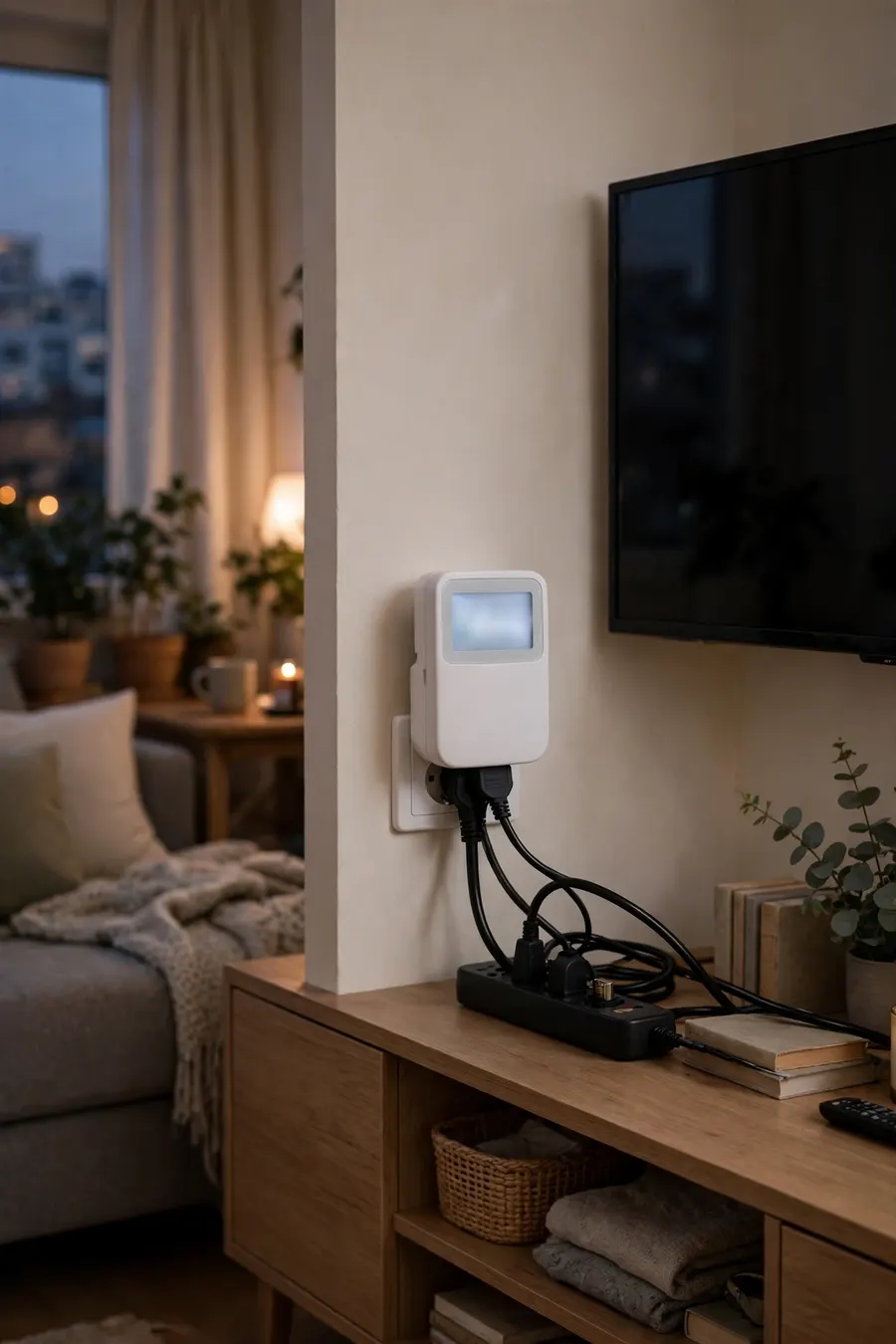
- The TV cluster. Cable box, console, streaming stick, soundbar. Put the whole stand on a smart power strip, so when the TV goes off, the strip cuts power to the hangers-on.
- The desk setup. Monitor, speakers, printer, laptop dock. Same trick, one strip, one switch.
- The always-on extras. Anything with a clock display or a little red eye that never sleeps is worth a look.
Smart plugs do the same job for single items on a schedule, like a fan or a charger station that only needs power overnight. If you want proof before you buy anything, a plug-in energy monitor tells the truth fast. Borrow one or buy one cheap unit, plug your entertainment cluster, then your oldest appliance into it for a day each, and you will know exactly which box deserves your attention.
Swap the Bulbs and Take Them With You
Lighting is a bigger deal in an apartment than most renters expect, and the FAQ below explains why. Start with the swap that costs the least and travels the best.
LED bulbs use a fraction of the energy of traditional bulbs, and Electric Kiwi’s savings guide puts the figure at up to 85 percent less. You do not need to change every bulb on day one. Start with the ones that burn for hours: the living room lamp, the kitchen light, the one by your reading chair. The closet bulb that runs four minutes a day can wait.

The renter part of this trick is the box. When you take the landlord’s bulbs out, put them in a labeled box in a cupboard instead of losing them in a drawer. On move-out day you swap them back in ten minutes, and your LEDs go into the moving box for the next place. It is one of the few energy upgrades you buy once and keep for years of renting.
The Showerhead Swap Nobody Notices
Hot water is heated water, and MoneyPPL’s breakdown of home energy use puts water heating second only to heating and cooling. So a showerhead that uses less water saves twice: less water, and less energy spent heating it.
Most showerheads unscrew by hand. A low-flow head goes on in about five minutes, usually with no tools at all. The original head goes into a bag under the sink, ready to swap back when you move. Faucet aerators work the same way: unscrew the little mesh cap, fit the efficient one, keep the original in the same bag.

Your landlord’s water heater is a different story. Most renters cannot even reach it, and the whole strategy here is one polite email. Ask whether the heater can be set to 120 degrees F, and mention that it lowers the appliance’s workload and reduces scald risk, which is in the landlord’s interest too. Then leave it alone. Do not touch a water heater that is not yours.
Summer Is Where the Apartment Bill Is Won
Most renters searching for how to lower the electric bill in summer in an apartment are really fighting one enemy: afternoon sun pouring through glass and an AC unit trying to push it back out.
Blackout or thermal curtains on the sunny side of the home make a real dent. Hang them on a tension rod if your lease bans drilling, close them before the sun hits the glass, and open them again once it passes. You are stopping the heat at the window instead of paying to remove it later.
Then pair the AC with a fan. Moving air feels cooler on skin, so a ceiling fan or a decent portable fan lets the AC setting sit a few degrees higher while the room feels the same. Those degrees are not trivial: Altus Power estimates that each degree of thermostat adjustment is worth roughly 3 percent of heating and cooling cost. Two honest notes. Fans cool people, not rooms, so switch them off when you leave. And if your window unit has a filter, rinse or clean it monthly through the season so the unit is not straining through dust.
If the apartment has its own thermostat, program a setback schedule for work hours and sleep hours and let it run itself. If it is a basic dial, a phone reminder morning and night builds the same habit for free.
Laundry, Kitchen, and the Fridge That Never Rests
Laundry savings are boring and real. Wash cold, because heating the water is the expensive part of a load. Run full loads only. If your building charges per load, a folding drying rack for part of the week quietly deletes whole paid cycles, and your clothes last longer for it.
In the kitchen, cook small meals in the microwave or a toaster oven instead of heating a full-size oven for one portion, and keep lids on pots so the heat stays in the food.
Then check the fridge. If it is yours to adjust, keep it at or below 40 degrees F and the freezer at 0 degrees F. Vacuum the coils if you can reach them. And if the fridge runs constantly, humming at you at 3 a.m., report it in writing. An old fridge is one of the biggest electricity hogs in a small home, and it is the landlord’s appliance wasting money on both sides of the lease.
Take It All With You
This is the quiet advantage of the renter approach. Nothing in this article is a donation to your landlord. The LED bulbs, the smart strips, the curtains, the showerhead, the drying rack, all of it fits in one moving box and starts saving again in the next apartment on day one.
Your move-out checklist is short: original bulbs back in their sockets, original showerhead and aerators back on, strips and curtains packed. Deposit intact, and you leave with a kit that already works.
Ask First, and Skip the Rest
- Check your lease before the showerhead swap. Most leases allow a hand-tightened, reversible fitting. If yours bans modifications outright, ask first. One email is cheap.
- If your heat is landlord-controlled, be honest about it. With radiators you often cannot turn the heat down at all. Try the radiator valve first if one exists. If the place still bakes and you are opening windows in January, report the overheating to the landlord in writing, because it is their fuel money too. Until then, your levers are the electricity-only ones in this article.
- Report problems as a list, not a complaint. Drafts around windows, a dripping hot tap, a fridge that never stops running. Those are the building’s assets wasting the building’s money, and landlords respond better to that framing.
And skip anything wired in, anything permanent, and anything that needs a hole you cannot make disappear. No saving is worth a deposit fight.
Frequently Asked Questions
Can a renter change the showerhead?
In most leases, yes. It is a hand-tightened fitting and fully reversible, which is why landlords rarely object. Keep the original head and swap it back when you leave. If your lease says no modifications at all, ask first. One email costs nothing.
What if I do not control my heat at all?
Then your levers are electricity-only: lighting, standby power, laundry and cooking habits, and window coverings that help in summer. Say so honestly and use the written-request route for the building-level stuff, like an overheating radiator or a dying fridge. You cannot fix what belongs to the building, but you can put it in writing.
Do LEDs really matter in a small apartment?
Yes, and arguably more than in a house. Lighting is a bigger share of a small home’s bill because there is no big heating and cooling load diluting it. Swap the bulbs you use for hours a day first and the effect shows up faster than you would expect.
Small Place, Smaller Bill
Renting limits your tools, but it does not limit them to nothing. The standby cluster, the bulbs, the showerhead, the curtains: each one is small, reversible, and yours to keep. Stack a few of them together and the next summer bill for that same small apartment looks a lot less like it belongs to a house with a pool. Learning how to lower your electric bill in an apartment is mostly learning what you actually control, and it turns out that is plenty.